Key Concepts
Concepts are like portals that open up new ways of thinking that were previously not possible. Our conceptual maps structure the ways we think and enlargening our conceptual maps makes new ideas possible. I collect concepts. Below are concepts (in no particular order) that have been portals for my thinking about education; each of these concepts have opened up new possibilities in the ways I think about education. These concepts have helped me identify problems, name vague feelings that I couldn’t put my finger on, challenged me. Some of these concepts are bricks that have come flying through my window, smashing what I thought I knew about education into pieces. These are concepts that I return to regularly and think-work-play with. Here’s a kind of glossary / treasure trove of concepts that are important to me, each coming from (what I would consider) outside of the “mainstream” in educational thought. Each concept is presented below with a short summary, one to three introductory readings, and a related video. This is, and always will be, a work in progress.
‘A concept is a brick. It can be used to build a courthouse of reason. Or it can be thrown through the window.’
Gilles deleuze
- discretionary spaces
- implied student
- windows, mirrors, and sliding glass doors
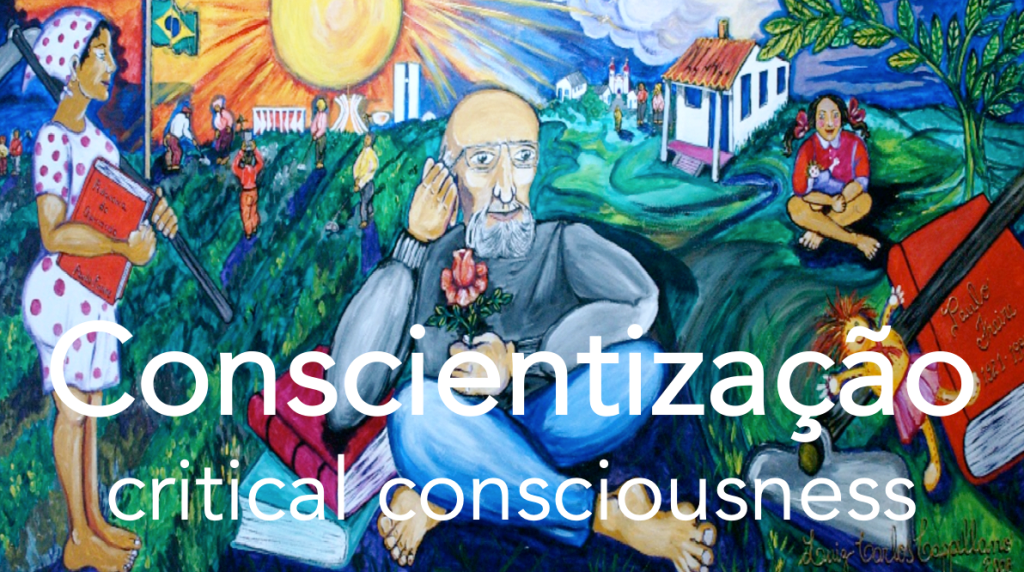
- conscientização (critical consciousness)
- cultural blocks and threads
- interculturalspeak
- exophony
- linguicism
- linguistic repertoire
- decolonisation
- anti-racism
- translanguaging
- third space
- unlearning
- curriculum violence
- Orientalism?
- intra-action
- thing-power
- autoethnography
- assemblage
A ‘discretionary space‘ is a concept developed by Deborah Loewenberg Ball to refer to a space in which ‘the next move or comment or question is necessarily determined by the teacher – and not by a policy, a curriculum, or a principal’ (Ball, 2019) and in which ‘teachers have the power to reinforce or disrupt patterns of racism, sexism, and marginalization‘ (Ball, 2019). Ball reminds us that teaching is dense with ‘discretionary spaces’ but ‘often we act without even realizing we have discretion to do something different’ so need to practice ‘habits of consciousness’ (Ball, 2019) to make these spaces into ‘an enormous resource for good’ through which ‘teaching can be practiced in ways that are culturally responsive to communities, that build on their resources and ways of knowing and doing, and that responsibly serve the children and families that are so often harmed’ (Ball, 2020).
Read:
Watch:
The ‘implied student’…
Read:
- Ulriksen (2009), The implied student
Watch:

This is…
Read:
Watch:
This is…
Read:
- .
Watch:
This is…
Read:
- .
Watch:
I first came across the concept of ‘interculturalspeak‘ in Fred Dervin’s work on interculturality and it became a valuable part of my vocabulary for critiquing common approaches to the intercultural in international schooling. Interculturalspeak refers to an ‘uncritical approach to intercultural matters’ (Li and Dervin, 2018: 12) in which the intercultural is spoken about ‘in a somewhat automatic, acritical way’ (Dervin and Simpson, 2021: 13). Interculturalspeak is ‘the visible and “cleanish” side of interculturality globally’ (Dervin et al., 2022: 102), that uses ‘phrases, mottos/slogans and words that are not critically or reflexively evaluated’ in ‘a somewhat automatic “robot-like” way’ (Dervin and Yuan, 2022: 80).
Read:
- Li & Dervin (2018), Interculturality in a Different Light: Modesty Towards Democracy in Education?
- Dervin & Simpson (2021), Interculturality and the Political in Education
- Dervin et al. (2022) Interculturality Between East and West: Unthink, Dialogue and Rethink
Watch:

This is…
Read:
- .
Watch:
 Jacob Huckle
